Reducing Barriers to Permanency:
A Resource for Judicial Officers
The Dave Thomas Foundation for Adoption is a national, nonprofit public charity dedicated to dramatically increasing the number of adoptions of children waiting in North America’s foster care systems. Our signature program, Wendy’s Wonderful Kids® (WWK), is focused on achieving legal permanency for young people most at risk of aging out of care without a family — youth ages 9 and older, children with special needs, and siblings. Judicial officers working in the child welfare system have a tremendous impact on the likelihood of finding legally permanent homes for youth. This resource provides an overview of the WWK program and how judicial officers can help promote permanency for the longest-waiting children and youth in foster care.
About Wendy's Wonderful Kids
Through Wendy’s Wonderful Kids, the Foundation provides grants to public and private agencies to support the hiring of adoption recruiters who implement an evidence-based, child-focused recruitment model.
Instead of working to find the right child for a permanent family, WWK recruiters strive to find the right family for the child. A key strategy within the child-focused recruitment model is to explore the child’s history and contact people with whom the child has a pre-existing relationship or connection. These people may serve as potential permanent placements or as sources of information to find a legally permanent home for that child.
WWK recruiters also seek the child’s input and invest time and energy in building a trusting relationship with them to gain a deeper understanding of the child’s needs and discover who is important in their life.
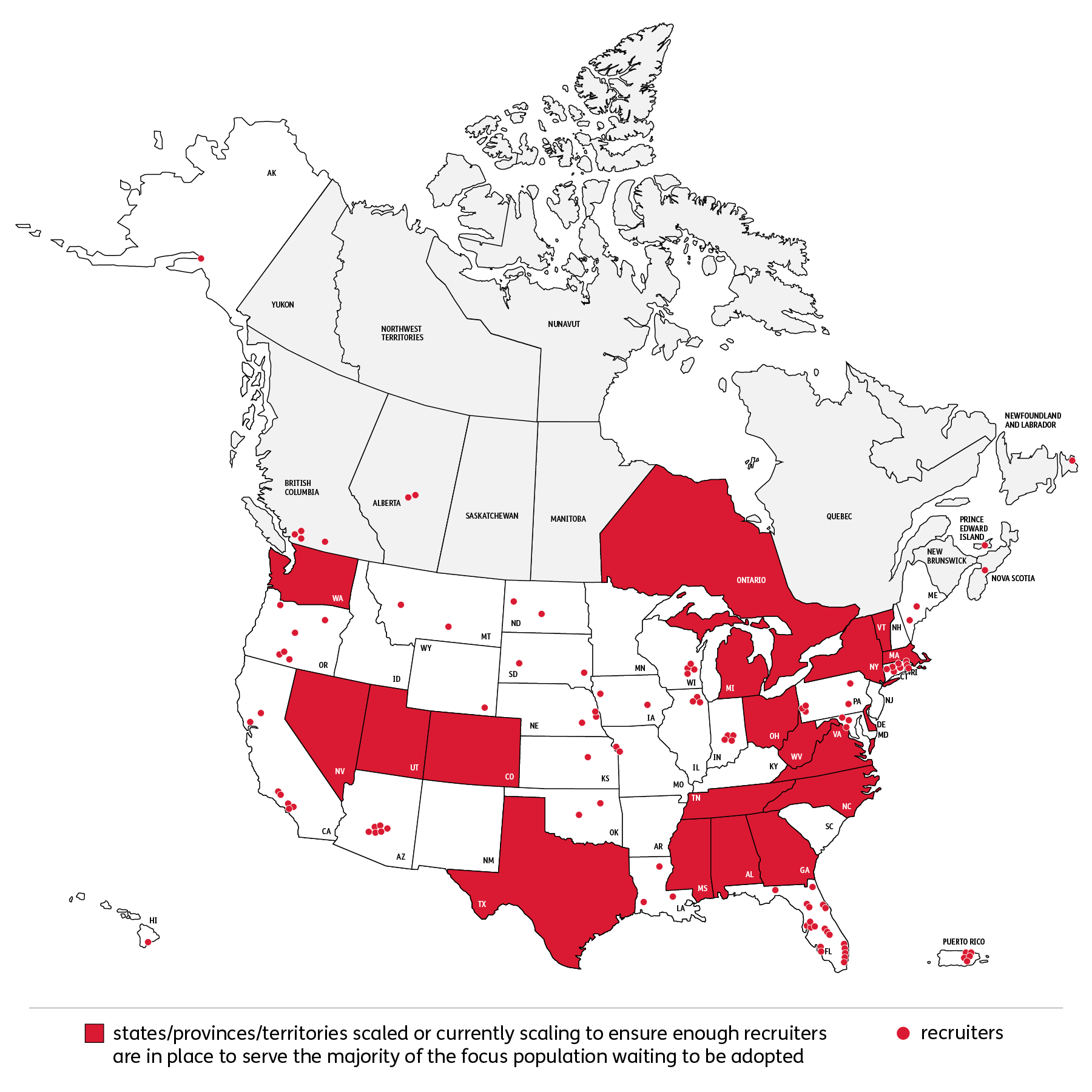
How You Can Help
Judicial officers play a vital role in ensuring that children are placed with the permanent families they deserve. Please consider the following actions that could help break down barriers to permanency in your state.
Federal law requires states to make reasonable efforts to finalize the permanent placement of a child in foster care. Traditional recruitment tactics, such as photo listings and match events, are not evidence-based and typically are not as effective for children most at risk of aging out of care. To meet the reasonable efforts burden to finalize a child’s permanent placement, youth should receive evidence-based recruitment services, such as the Wendy’s Wonderful Kids program. In cases where there is no capacity on a WWK recruiter’s caseload or no WWK recruiter in the area, judicial officers can order recruitment activities that work with the youth to identify the people who are important in their life and focus on revisiting all relatives and others known to the youth to achieve legal permanency.
Learn more about the process of referring youth to Wendy’s Wonderful Kids.
Too often, youth waiting in foster care are considered too old or too unstable for a permanent home. Every child, no matter their age or journey through the child welfare system, is adoptable. WWK recruiters successfully find families who are committed to the child as they are today rather than expecting their behavior to change. To view a child as unadoptable can sometimes cause courts to hesitate in terminating parental rights due to a fear that the child will not be adopted and will age out as a “legal orphan.” However, the results of the WWK program show that all children are adoptable when given the right recruitment efforts. As a judicial officer, it is important that you believe that the children on your docket deserve the opportunity for legal permanency and make decisions aligned with that goal.
Placement stability is appealing for children who have experienced multiple placements and appear to be doing well at a group or foster home. Many of these youth are given a goal of long-term foster care or Another Planned Permanent Living Arrangement to maintain placement stability, yet they are left without long-term support after leaving the foster care system. This often leads to negative outcomes, such as higher rates of homelessness, unemployment, and lack of education.
Legal permanency — through adoption, legal guardianship, or reunification (when appropriate) — ensures that youth will have the long-term support necessary to successfully transition to adulthood. While the child welfare system should anticipate upheaval during the adoption preparation process as youth confront their trauma and work through their grief, it is worth stepping outside of comfort zones by both the system and the child so that we can find a legally permanent, lifelong family for every child. Judicial officers can prioritize legal permanency by questioning requests that place youth in Another Planned Permanent Living Arrangement or keep them in foster care or group home placements. By pushing for legal permanency over placement stability, judicial officers can help ensure that youth receive the supports they need throughout life.
Explore 5 best practices for achieving legal permanency for children in foster care.
Family of origin has multiple roles in supporting a child’s journey to permanency. WWK recruiters find it beneficial to re-approach family members even after they were ruled out as a placement option earlier in the process. The family’s situation may have changed during the child’s time in foster care in a way that allows them to serve as a permanent placement. When placement is not an option, contact with family of origin can provide vital information to expand the network of potential placements for the child. These connections can also reassure and give the youth permission to move forward when a permanent placement is found. Judicial officers can recognize the family’s important role in recruitment by supporting recruiter contact with the family of origin and narrowly tailoring no contact orders to apply only to the child (not the professionals in the child’s case).
Many children in foster care are initially hesitant or even fully opposed to the concept of legal permanency. They have faced trauma and learned to say “no” as a selfprotection mechanism to avoid rejection. The Foundation has consistently heard from WWK recruiters that the most common fear children have related to permanency is that no one will want them. Other fears include:
Fear of the unknown | Fear of being re-abused | Wondering if they will be safe and happy with their new family | Normal teen feelings of wanting to be independent | Changing schools and last names | Wondering what new family rules will be | Leaving communities and friends | Fear of rejecting or hurting their biological family | Not trusting adults because of past abuse, trauma, grief, and loss in their lives | Being separated from siblings | Fear that no one will want them
Laws that require the youth’s consent to adoption and other forms of permanency can create barriers to the recruitment process. Judicial officers have sometimes responded to the youth’s initial hesitancy by advocating all recruitment efforts to cease. However, WWK recruiters find that a youth’s resistance to permanency often diminishes once they identify the child’s specific fears and work to address them. Finding the right family for the youth (particularly a family they already know) can also alleviate those concerns.
Judicial officers can help a youth unpack their initial “no” to permanency by ordering a WWK recruiter to work with youth who are hesitant to consider their permanency options. Do not allow a youth’s concerns about permanency to preclude them from receiving recruitment services. Allow the recruitment team to explore the reasoning behind the youth’s hesitancy and consider recruitment plans and placements that help to alleviate those fears.
Often, there is reluctance to pursue permanency for older youth in foster care due to a misunderstanding that the limited and temporary support offered by the child welfare system through independent living services and extended foster care can replace family as a safety net. Electing to age out solely to receive these benefits can be shortsighted.
Receipt of benefits under extended foster care programs often have eligibility requirements that are difficult for youth to maintain. Youth also may hesitate to continue to engage with the child welfare system to recieve extended foster care benefits. Family provides long-term relationships and support that can never be replaced — a place to go for the holidays, life advice, a safety net during life’s inevitable challenges, and support for future generations as youth begin their own families. Judicial officers should weigh the limited supports of extended foster care, including the youth’s likelihood of eligibility, against the long-term benefits of a permanent family when reviewing case plan goals, and placement decisions. To better understand this issue, visit the Foundation’s YouTube channel for videos of youth sharing why having a permanent family is so important.

Child-Focused Recruitment Model
While other types of adoption recruitment can be successful, child-focused recruitment has been proven to be the most effective approach to achieving permanency for the program’s focus population of teenagers, children with special needs and siblings who are too often overlooked.

Initial Child Referral
Introduce recruiter’s role to caseworker and learn basics about child

Case Record Review
Take a deep dive into child’s case record to find significant people from the past

Relationship With Child
Meet with child monthly to build trust and understand child’s needs

Diligent Search
Identify and contact people with whom the child has had a relationship

Network-Building
Work with all people involved with child

Assessment of Adoption Readiness
Determine if child has needs to address before moving forward with adoption

Adoption Preparation
Assure child is ready for process and family is ready to meet child’s needs

Recruitment Plan
Customize comprehensive plan to find adoptive family based on child’s needs
In 2011, Child Trends released a five-year, national randomized control trial evaluation that found the child-focused recruitment model to be dramatically more successful than business as usual in child welfare1:
Children served by
the model were
1.7x
more likely to be adopted
Older children
were up to
3x
more likely to be adopted
Children with mental
health issues were over
3x
more likely to be adopted
I was scared, I was lost, and I felt hopeless. I came to terms that I am alone and that I am going to be alone forever. Once I got into a family, my world started to change, my future started to change. The little things — cooking with them, shopping with them, walking with them — mean so much to me. I didn’t think that I’d have a family again. I didn’t think that I’d go to college. I didn’t think that I would have love. I just feel that my world is so much brighter.